The Battle of Midway, by the Minute
Six Minutes That Turned an Unwinnable Battle
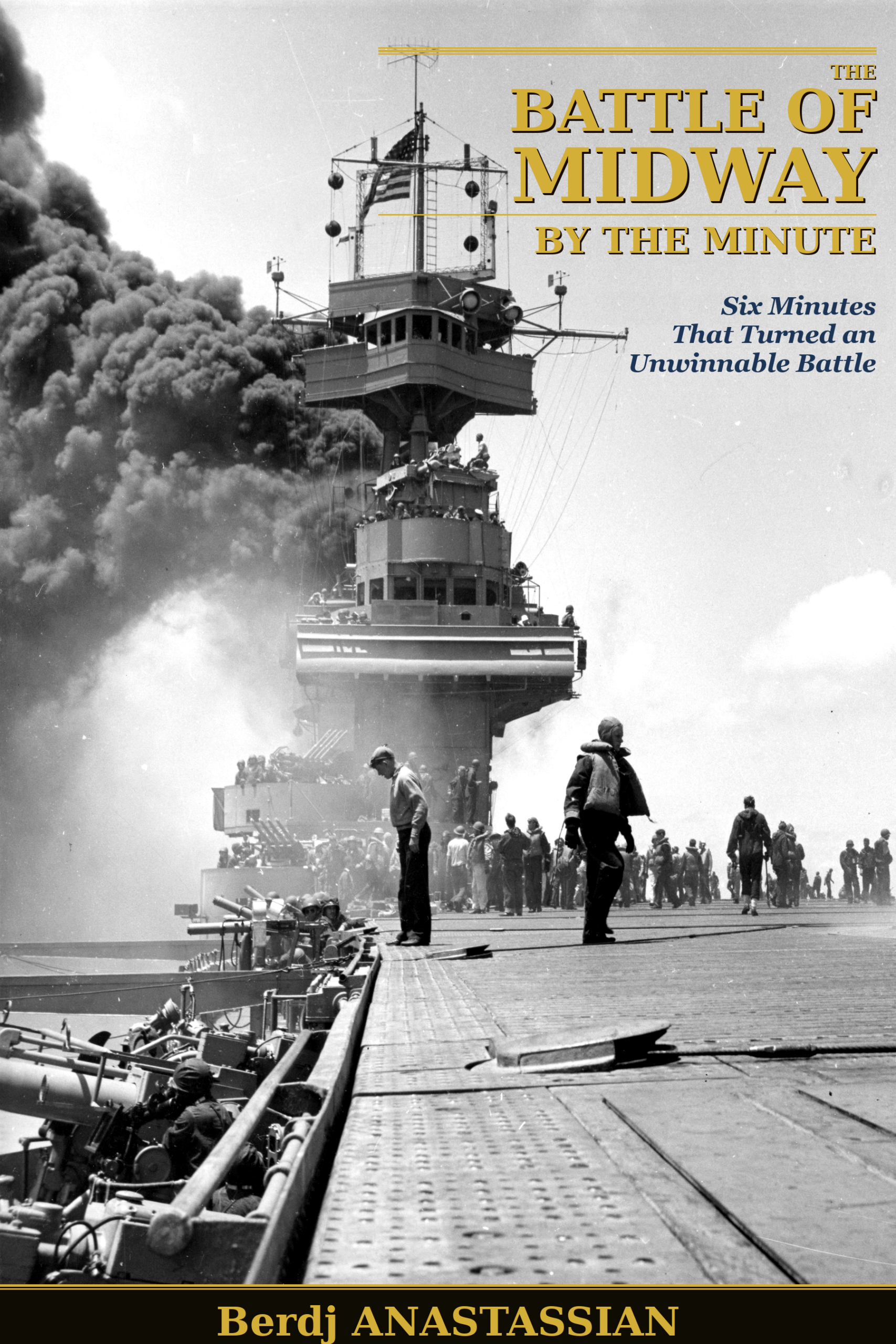
Dawn, 4 June 1942. Somewhere in the Pacific Ocean, four of the most powerful aircraft carriers ever built are preparing to strike. Their crews are battle-hardened, their pilots the finest in the world. Six months earlier, they shattered the American Pacific Fleet at Pearl Harbour. Nothing has stopped them since.
They do not know that three American carriers are waiting for them, just over the horizon.
What follows will last less than six minutes.
Everyone knows Japan lost the Battle of Midway. Far fewer know why — or how close it came to going the other way.
In The Battle of Midway, by the Minute, Berdj Anastassian strips the battle down to its bare bones and rebuilds it moment by moment, from the first patrol flights of 3 June to the last dive bomb that sealed Japan’s fate. Drawing on the most authoritative sources available — including Japanese operational reports, pilot testimonies, and the decoded intelligence that changed everything — he asks the questions that history books often gloss over.
Why did Nagumo hesitate at the moment that mattered most? What would have happened if Yamamoto had played his hand differently? And how did six minutes of dive bombing alter the course of the entire war?
This is not a book for specialists only. Written with the clarity of a pilot’s briefing and the pace of a thriller, it places the reader in the cockpit, on the bridge, and in the operations room — minute by minute, decision by decision — as the fate of the Pacific is decided overhead.
You already know how it ends. You have no idea what happened.
Where to buy
Available in print
IngramSpark — Global distribution
Hardcover and paperback — worldwide shipping
Coming soon
Amazon
Available through Amazon marketplaces worldwide
Coming soon
Your local bookshop
Ask your local bookshop to order via IngramSpark distribution
Coming soon
Historical background
The Battle of Midway — Why it matters
Why Midway?
By the spring of 1942, Japan had achieved virtually everything its pre-war planners had dared to dream. Admiral Isoroku Yamamoto, commander of the Combined Fleet, understood better than anyone that Japan had not destroyed American naval power — it had only wounded it. The US carriers had escaped Pearl Harbour. They had raided Tokyo. They had fought the Kido Butai to a draw at the Coral Sea. Midway was his answer: a tiny atoll sitting astride the most direct route between Japan and the American West Coast. One decisive victory, and the Americans would have no choice but to negotiate.
The odds
Japan committed eight aircraft carriers, eleven battleships, twenty-two cruisers, sixty-five destroyers and more than 700 aircraft to the operation. Against them, the United States could field three carriers — one of them, Yorktown, so badly damaged at the Coral Sea that Japanese intelligence believed her sunk. She had been repaired in 72 hours at Pearl Harbour. What Japan did not know was that the United States had broken their naval code. Admiral Chester Nimitz knew the date, the direction and the strength of the Japanese attack before a single ship left port.
The six minutes
On the morning of 4 June 1942, between 10:22 and 10:28, three American dive bomber squadrons found the Japanese carriers at the precise moment their decks were crowded with fully fuelled and armed aircraft. Akagi, Kaga and Sōryū were all hit in less than six minutes. All three sank before the day was out. Japan lost four fleet carriers, over 250 aircraft, and — most irreplaceable of all — the core of her experienced naval aviators. The Battle of Midway did not end the Pacific War, but it ended any realistic possibility of Japan winning it.